How to Understand Bill Gates's AI Warning About Catastrophic Risk and Weak Regulation
Want articles like this for your own video to promote it on YouTube and Google? Order them through the Telegram bot @sat_sit_bot. The bot writes and publishes the articles itself (with your YouTube video embedded) on popular topical websites (no ads). Try it free: 50 articles on us.
· based on the channel The Ezra Klein Show
Key takeaways
- Gates calls AI the most dangerous technology humanity has approached, saying it makes nuclear weapons look like nothing.
- He argues industry self-regulation is 'insane' and that lawsuits cannot answer a catastrophe killing 100 million people.
- Gates names two thresholds first: catastrophic cyberattacks and bio-terrorism enabled by AI tools.
- He warns of mass job loss and proposes ideas such as taxing AI labor and 'human reserved' roles.
- The Gates Foundation is set to spend about $200 billion over two decades, with AI equality as a new priority.
Bill Gates's answer to how to understand the AI risk debate is blunt: treat artificial intelligence as the most dangerous technology humanity has approached, assume industry self-regulation will fail, and push governments to set hard thresholds for cyber and biological threats before the damage is done. In his conversation with Ezra Klein, Gates argues that AI "makes nuclear weapons look like nothing" and that the people in positions of authority are largely in denial about what is coming. The full transcript and episode are available at the New York Times page for the Ezra Klein podcast.
What Gates actually changed his mind about
Gates spent years as a technology optimist who treated AI timelines as distant and overstated; he now says the capability curve arrived faster than he expected and that his earlier skepticism was wrong. The shift matters because it comes from someone with deep technical knowledge and a long record of funding global health work, not from a critic outside the industry. He describes a moment when systems crossed into territory he considers superhuman on specific tasks, and he frames the question as one of readiness rather than possibility. The practical takeaway for readers tracking AI policy is that the debate has moved from whether the technology will be transformative to whether institutions can absorb the speed of the change.
The two thresholds Gates wants governments to watch
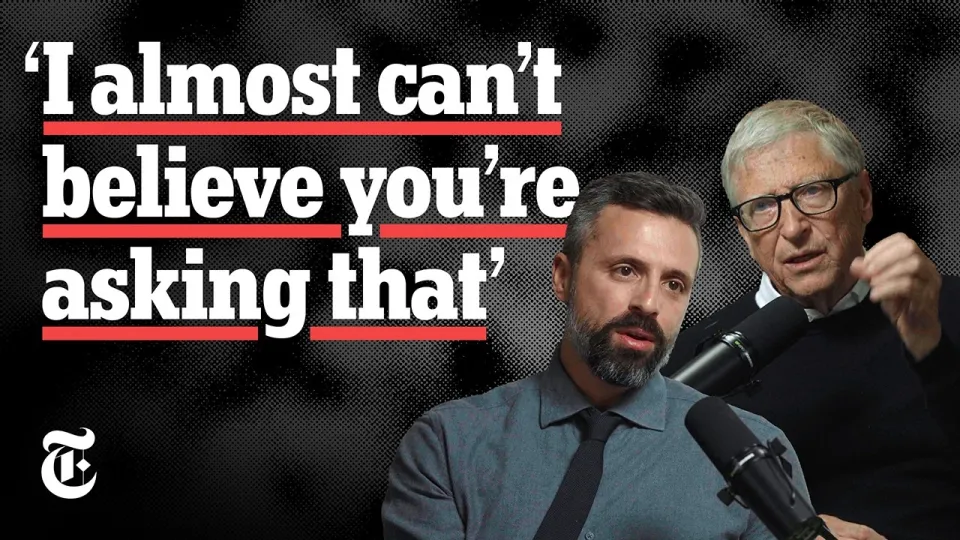
Gates identifies cyber and bio as the first domains where AI could cause harm at a scale no legal system can repair after the fact. On cyber, he warns of catastrophic attacks that could disable infrastructure; on bio, he warns that AI could lower the barrier for someone to design and release a dangerous pathogen. His argument is that these are not hypothetical philosophical risks but concrete capability thresholds that can be measured, monitored, and regulated in advance. The implication is a licensing and testing regime tied to capability levels, not to promises from companies. When Klein raises the idea of holding labs liable through courts, Gates's response is close to disbelief: a lawsuit is no answer to an event that kills 100 million people.
Why self-regulation fails in Gates's view
Gates calls the notion that the AI industry can police itself "insane," and his reasoning is structural rather than personal. Companies compete on speed, capital, and market share, and the incentives that make them successful are the same incentives that push safety work to the margins when a release deadline approaches. He points out that the firms building frontier models are not charities and that voluntary commitments have no enforcement mechanism when a lab decides the risk is acceptable. Regulation, in his framing, has to come from outside the industry, with defined red lines, audit rights, and consequences for crossing them. That position puts him at odds with executives who argue that capitalism supplies its own remedies, a tension Klein presses on directly during the episode.
The race with China and the cost of slowing down
Gates does not argue for a pause; he argues for rules that apply broadly enough that no single country gains an advantage by ignoring them. He frames the US-China dynamic as a competition that makes unilateral restraint costly, which is why he favors international coordination on the most dangerous capabilities rather than a blanket slowdown. The tension is real: safety measures that only bind one side simply relocate the risk. His preferred approach is to define a small set of genuinely catastrophic risks, agree on them across borders, and let competition continue everywhere else. Listeners who want the full exchange can follow the show through The Ezra Klein Show and read the transcript at the link above.
Jobs, taxes, and the idea of human-reserved work
Gates expects AI to disrupt labor on a scale that current policy tools are not built to handle, and he offers several concrete ideas rather than a single fix. He discusses taxing AI labor as a way to fund the transition, a proposal economists debate because it can slow adoption and is hard to define in practice. He also raises the notion of "human reserved" jobs, roles where society deliberately keeps people in the loop for reasons of trust, dignity, or accountability. A no-scarcity job market, in his telling, would require new institutions rather than a simple redistribution check. He extends the argument to developing nations, where AI could either compress decades of development or widen the gap depending on who controls the models and the compute.
What the audience pushed back on
The most common reaction to the episode was that Gates sounded more alarmed than viewers expected, and that alarm is the story. Many listeners noted his visible frustration when Klein proposed litigation as a remedy, and others asked why a technologist who built one of the world's largest companies would now argue for heavy government limits. The answer he gives is that the downside scenario is not a market failure but an irreversible one. A second cluster of questions concerned Jensen Huang's view that market incentives protect consumers, which Gates rejects by pointing to a century of harms that markets did not prevent on their own. A third theme was credibility: viewers asked whether a foundation spending roughly $200 billion over two decades on health and equality can meaningfully shape AI governance, and Gates's response is that the foundation's new AI priority is about directing the technology toward the poor rather than about writing the rules.
Education, children, and the next policy frontier
Gates treats education as both an opportunity and a warning, arguing that AI tutors could raise outcomes in places that lack teachers while also accelerating learning loss if deployed without guardrails. He points to evidence that rich countries already saw learning loss after the pandemic, and he worries that unstructured AI use in classrooms will deepen it. He supports age-specific regulation for children's use of AI, including limits on data collection and design features that keep minors engaged. The broader point is that AI policy is not one law but a stack of domain-specific rules: health, education, elections, and national security each need their own thresholds. The episode closes with book recommendations, which the show lists at the official book recommendations page.
Useful links
- Full transcript and episode page
- Book recommendations from Ezra Klein Show guests
- The episode on YouTube
The bottom line
Gates's message is that AI risk is not a future abstraction but a present governance gap, and that the tools available to close it are laws, testing regimes, and international agreements rather than voluntary pledges. He wants readers to stop treating catastrophic cyber and bio scenarios as science fiction and to start asking which institution is responsible for preventing them. The discomfort in the interview is the point: a technologist who spent his career betting on progress is now betting that we are unprepared for the progress we are making. For the full argument in his own words, read the transcript at the New York Times episode page. This analysis draws on the conversation published by The Ezra Klein Show.
Source: Bill Gates: A.I. ‘Makes Nuclear Weapons Look Like Nothing’ | The Ezra Klein Show · Markdown version
Questions & answers
Why does Bill Gates say AI makes nuclear weapons look like nothing?
Gates argues that AI-enabled cyberattacks and bio-terrorism could cause harm at a scale and speed that existing institutions cannot respond to, unlike nuclear weapons where deterrence and treaties exist. He treats AI as a general-purpose capability that lowers the barrier for many kinds of attacks at once.
What does Gates propose instead of industry self-regulation?
He wants external regulation with defined capability thresholds, testing before release, audit rights, and consequences for labs that cross red lines. He rejects voluntary commitments because competitive pressure makes them unenforceable when a release deadline approaches.
Is Gates calling for a pause on AI development?
No. He argues for coordinated international rules on a small set of catastrophic risks while letting competition continue elsewhere, because unilateral restraint would simply shift the advantage to countries that ignore the rules.
What does Gates say about AI and jobs?
He expects large-scale labor disruption and discusses taxing AI labor to fund the transition, along with the idea of human-reserved roles where people stay in the loop for trust and accountability. He frames the challenge as building new institutions rather than relying on a single policy fix.